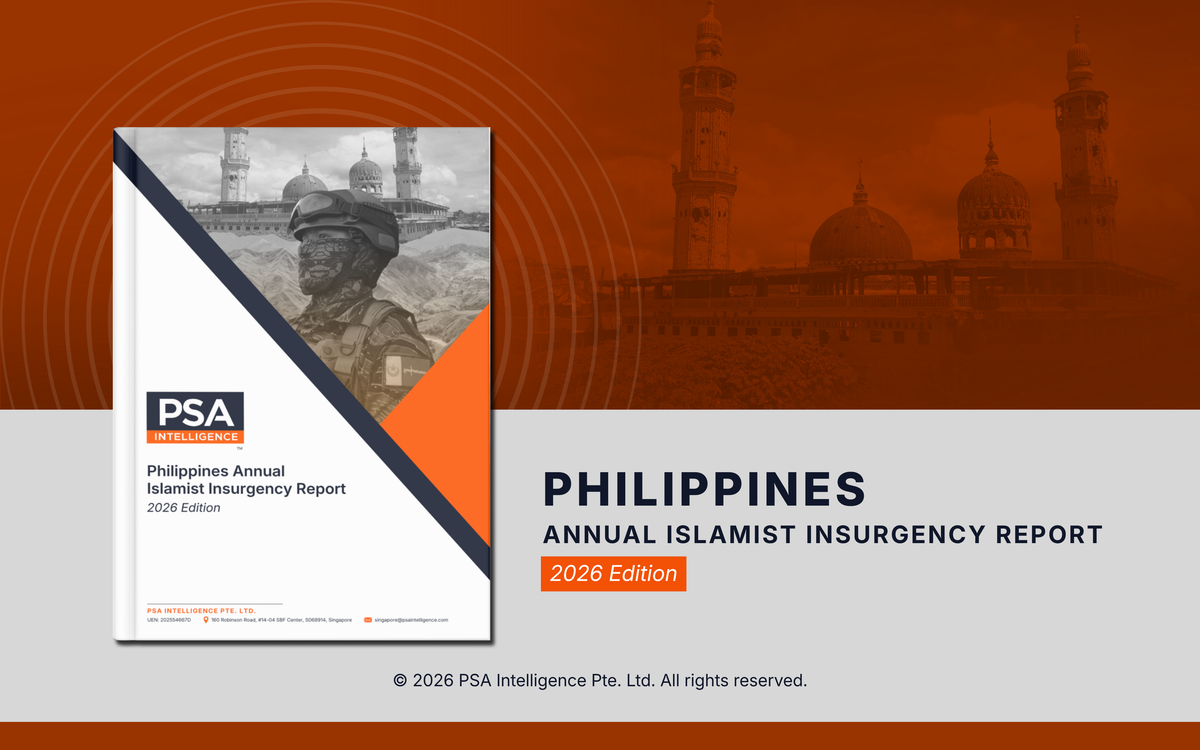
Philippines Annual Islamist Insurgency Report - 2026 Edition
PSA Intelligence's Philippines Annual Islamist Insurgency Report - 2026 Edition discusses identified trends in Islamist insurgent and terrorist activity in the Philippines in 2025, the capabilities of threat group remnants in 2026, and what these mean for organizations operating in high-risk areas.
Executive Summary
- Security gains stemming from government security operations against the remnants of local Islamist armed groups in Mindanao have remained steady throughout 2025. No major attacks against both government forces and civilians occurred during this period, and the trend of Islamist-related violent incidents is overall declining.
- Most of the fifty-four (54) Islamist-related violent incidents in 2025 were armed encounters from government-initiated operations or rido (clan feuds). The geographic concentration of Islamist-related violent incidents remained in the Bangsamoro region and its neighboring provinces.
- Remnants of Islamist threat groups were still not able to stage any significant attacks against civilians and the private sector in 2025.
- The most active threat groups outside of the peace process in 2025 continued to be the BIFF and the Maute Group. Incidents attributed to these groups were concentrated in their respective bailiwicks in the Maguindanao and Lanao provinces.
- While the MILF is no longer considered an active insurgent group due to their participation in the peace process, PSA Intelligence analysts continue to record encounters between the MILF and government to a limited extent. Suspects not explicitly affiliated with any Islamist groups also continue to account for a majority of violent incidents in BARMM and its surrounding provinces.
- The implementation of the peace process between the MILF and Philippine national government was tested by political turmoil between the two parties and the MILF’s discontent with the government’s implementation of peace process-related programs. PSA Intelligence assesses that without significant headway in resolving these issues, the peace process may become more fragile than in past years, but still remain formally intact.
- The Bangsamoro Parliamentary Elections (BPE) are officially scheduled for Monday, September 14, 2026 after multiple postponements since 2021. PSA Intelligence maintains its assessment that a major role for the MILF in the first elected BARMM government will be favorable in protecting the region’s existing security gains and making them more permanent.
- PSA Intelligence remains largely of the view that the threat posed by Islamist threat groups in the Philippines will still be in decline in the short term. The situation in the medium to long term will be more complex, and PSA Intelligence analysts remain generally cautious of Islamist groups’ remnants and their abilities to regroup.
- PSA Intelligence reiterates that the threat of Islamist violence against civilians and the private sector will likely remain in decline while not disappearing altogether. As a general rule, any travel and activity in the area should be coordinated and consulted with private security/risk advisors like PSA Intelligence and with local government officials when possible, and done with professional security measures in place.
PSA Intelligence Security Analyst Team Inside
The PSA Intelligence team of security and risk analysts monitor thousands of intelligence sources across the Philippines and broader APAC region daily. PSA Intelligence supplies well-known international corporate security operations centers and enterprise risk management teams the reports and data required for their operations.
Contact us to for access to our regular risk management reports and data-feeds. Be sure to talk to us about our analyst vetted, reliable data feeds for your AI driven risk management systems too. We have 20+ years of back-data and keep the data acquisition pipelines running so you don't have to.
PSA Intelligence: Regional Reporting Capabilities
Our fast-paced intelligence pipeline is driven by a dedicated team of Manila-based security analysts that monitor the Philippine landscape every day. We bring together on-the-ground local insight with large scale data monitoring and cut through the noise to deliver the concise, actionable intelligence that our clients rely on to navigate their risks.
Regular Briefs & Industry Monitors
We provide a weekly digest of key political, economic, and security developments and analysis of their short and long-term impact on the local and regional business environment. Our Industry Monitors deliver regular summaries of key developments in manufacturing, energy, mining, and tourism.
Our Cyber Risks Briefs detail emerging cyberthreats, digital security vulnerabilities, and regulatory shifts, while our Economic Briefs provide macroeconomic snapshots covering inflation, trade markers, and fiscal policy. We also publish Health Risks Briefs tracking local disease statistics and healthcare capacities.
Targeted Crime & Kidnapping Reports
Our teams produce continuous updates and analysis on developing crime and safety trends targeting corporates and staff, ranging from opportunistic petty crime to syndicated criminal activity. This includes deep dives on known modus operandi, suspect profiles, and sociopolitical environments.
Additionally, we monitor Kidnapping Related Incidents in the Philippines, tracking publicly-known abduction cases, motives, victim profiles, and the broader regional developments that influence these threat vectors.
Insurgency, Terrorism, and Civil Unrest
We conduct ongoing analysis of activities of Communist insurgents in the Philippines, including their estimated operational capabilities, regional hotspots, and the progress of government peace processes.
Our coverage extends to Islamist Insurgency and Terrorism in Mindanao, assessing activities not limited to terrorism-related motivations but also criminal, personal, and cultural factors. We provide continuous assessments of political stability, strikes, protests, and broader civil unrest dynamics affecting operational continuity.

Ask an Analyst
Do you have a question regarding this report that you would like to ask our team of security and risk analysts? Ask here.
Query Sent
Thank you. Our intelligence team will respond to your query shortly.