Philippines Annual Kidnapping Report - 2026 Edition
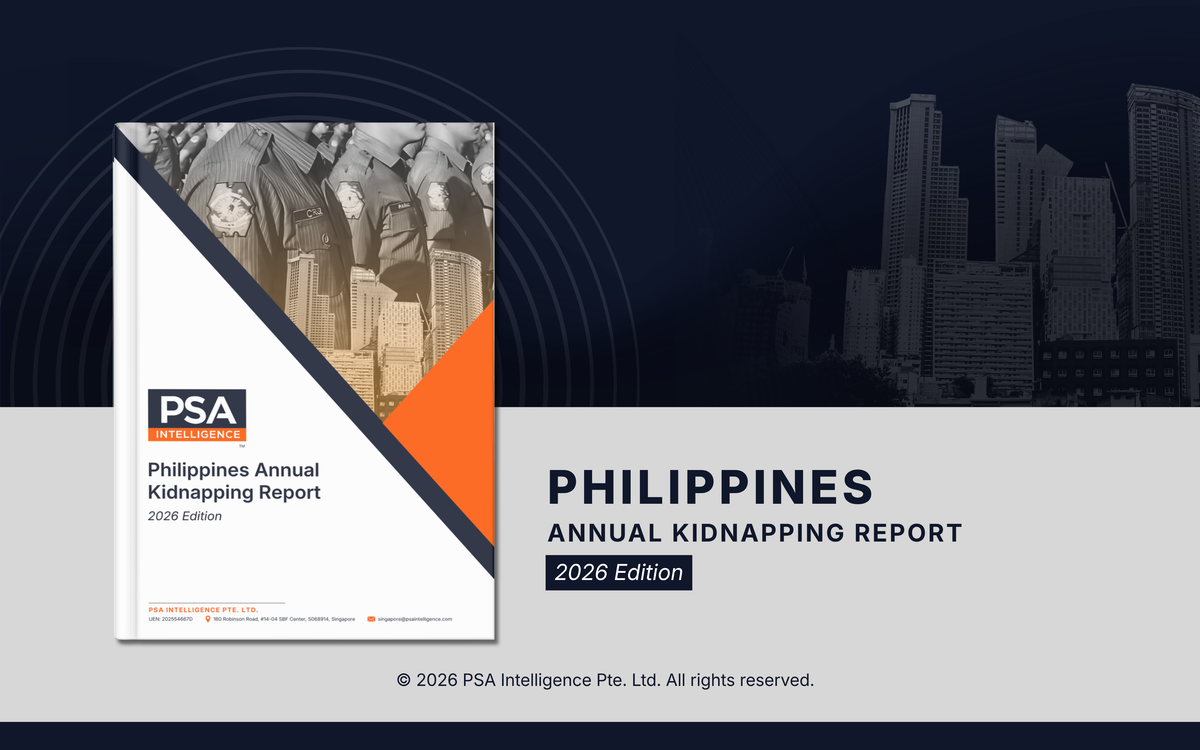
PSA Intelligence's Philippines Annual Kidnapping Report - 2026 Edition discusses the risk of kidnapping in the Philippines, highlighting threat actors' modus operandi, identified trends of victims and perpetrators, and risk mitigation measures for individuals, families, and organizations.
In 2025, PSA recorded the lowest number of kidnapping incidents since 2015. It is difficult to definitively conclude whether this signifies a medium or long-term declining trend in actual kidnapping incidence in the Philippines. Nonetheless, the present situation remains vastly different from the historical heights of syndicated kidnapping in the 1990s and early 2000s. The kidnap-for-ransom threat against foreign expatriates, especially Western nationals, remains very low, with no recorded abductions against Western nationals in 2025.
Almost half of all abductions in 2025 were financially motivated, of which most were for ransom. Kidnap-for-ransom incidents in 2025 were still primarily identified with Chinese syndicates or individual Chinese suspects targeting ethnic Chinese victims. While diaspora abductions have been in decline since at least 2021, analysts still recorded numerous incidents involving ethnic Chinese suspects targeting ethnic Chinese victims with no explicit disclosures of whether the involved personalities were associated with the POGO sector. It is not always clear whether these Chinese-on-Chinese abductions were connected to the POGO industry or organized crime, though analysts believe this is highly likely.
The offshore gaming (POGO) ban enacted in December 2024 has been associated with a relative decrease in related crimes such as kidnapping in 2025, especially as the POGO sector has been associated with increased overall kidnapping incidence since 2017. There were initial concerns that the abolition of the POGO sector would lead to a spillover of its associated threat actors’ criminality to victim groups outside of its typical targets. In PSA’s view, the abolition of the POGO sector has not necessarily led to a significant spillover of POGO-associated criminality to populations outside of the sector when overall incidence is taken into account.
An emerging modus operandi in some local kidnap-for-ransom incidents in 2025 is the use of cryptocurrency for ransom payment as explicitly demanded by suspects. The use of cryptocurrency in kidnap-for-ransom cases drew national attention with the kidnap-murder of Anson Que, where authorities uncovered a complex ransom payment network involving casino junket operators and several foreign e-wallet and cryptocurrency accounts. In Mr. Que's case, the suspects explicitly demanded the family to convert the ransom to cryptocurrency, which they did through casino junket services.
At least one "wrench attack," a globally emerging violent crime modus that involves the deliberate targeting of high-value individuals with known wealth in cryptocurrency, was recorded in the Philippines in 2025. Wrench attacks and “crypto-kidnappings” are known to be short and quick as the intention is to get access to the victim’s crypto-trading accounts as soon as possible. In the recorded local case, the perpetrators were unsuccessful in extracting the victim's cryptocurrency.
Most recorded crypto-related incidents are unclear on whether perpetrators targeted the victims for their known cryptocurrency wealth or if they simply wanted the ransom to be paid in cryptocurrency. Nonetheless, PSA notes that cryptocurrency is an emerging currency whose associated risks are still being understood, and therefore safeguards are difficult to definitively lay down.
PSA recorded the involvement of confirmed, rogue government security forces as perpetrators in some kidnap-for-ransom incidents in 2025. The involvement of confirmed government security personnel in kidnap-for-ransom incidents is typically facilitated by former uniformed personnel who offer their learned skills to criminal actors for personal gain, or by disgruntled personnel regardless of current status. While there remains a low recorded incidence of rogue government security forces’ involvement in kidnapping overall, their recorded involvement specifically in kidnap-for-ransom incidents between 2024 and 2025 is worth noting.
PSA did not record any Abu Sayyaf Group (ASG) abductions for the fourth straight year. However, PSA notes the suspected involvement of other Islamist threat groups in at least two incidents in Mindanao, including the kidnap-murder of three local goat traders in Maguindanao del Sur. Analysts are of the view that this incident shows how there are still remnants of Islamist militants who retain the training and remain available to carry these kinds of incidents out for financial gain. The links between criminal and terrorist actors especially in Mindanao have long been established, along with the porousness of the spheres within and across which these actors move. To this end, the likelihood of isolated incidents such as these are low but non-negligible.
Nonetheless, the Abu Sayyaf kidnapping threat in the southern Philippines still remains much lower than it was when the group was at its peak, with significantly diminished operational capabilities and a lack of leadership that has been consistently observed in at least the last five years. Analysts do not see any indicators at present suggesting that this will significantly change in the short term.
PSA Intelligence Security Analyst Team Inside
The PSA Intelligence team of security and risk analysts monitor thousands of intelligence sources across the Philippines and broader APAC region daily. PSA Intelligence supplies well-known international corporate security operations centers and enterprise risk management teams the reports and data required for their operations.
Contact us to for access to our regular risk management reports and data-feeds. Be sure to talk to us about our analyst vetted, reliable data feeds for your AI driven risk management systems too. We have 20+ years of back-data and keep the data acquisition pipelines running so you don't have to.
PSA Intelligence: Regional Reporting Capabilities
Our fast-paced intelligence pipeline is driven by a dedicated team of Manila-based security analysts that monitor the Philippine landscape every day. We bring together on-the-ground local insight with large scale data monitoring and cut through the noise to deliver the concise, actionable intelligence that our clients rely on to navigate their risks.
Regular Briefs & Industry Monitors
We provide a weekly digest of key political, economic, and security developments and analysis of their short and long-term impact on the local and regional business environment. Our Industry Monitors deliver regular summaries of key developments in manufacturing, energy, mining, and tourism.
Our Cyber Risks Briefs detail emerging cyberthreats, digital security vulnerabilities, and regulatory shifts, while our Economic Briefs provide macroeconomic snapshots covering inflation, trade markers, and fiscal policy. We also publish Health Risks Briefs tracking local disease statistics and healthcare capacities.
Targeted Crime & Kidnapping Reports
Our teams produce continuous updates and analysis on developing crime and safety trends targeting corporates and staff, ranging from opportunistic petty crime to syndicated criminal activity. This includes deep dives on known modus operandi, suspect profiles, and sociopolitical environments.
Additionally, we monitor Kidnapping Related Incidents in the Philippines, tracking publicly-known abduction cases, motives, victim profiles, and the broader regional developments that influence these threat vectors.
Insurgency, Terrorism, and Civil Unrest
We conduct ongoing analysis of activities of Communist insurgents in the Philippines, including their estimated operational capabilities, regional hotspots, and the progress of government peace processes.
Our coverage extends to Islamist Insurgency and Terrorism in Mindanao, assessing activities not limited to terrorism-related motivations but also criminal, personal, and cultural factors. We provide continuous assessments of political stability, strikes, protests, and broader civil unrest dynamics affecting operational continuity.

Ask an Analyst
Do you have a question regarding this report that you would like to ask our team of security and risk analysts? Ask here.
Query Sent
Thank you. Our intelligence team will respond to your query shortly.